
Cats Eat Meat! Phasing out kibble for cats at The Happy Beast
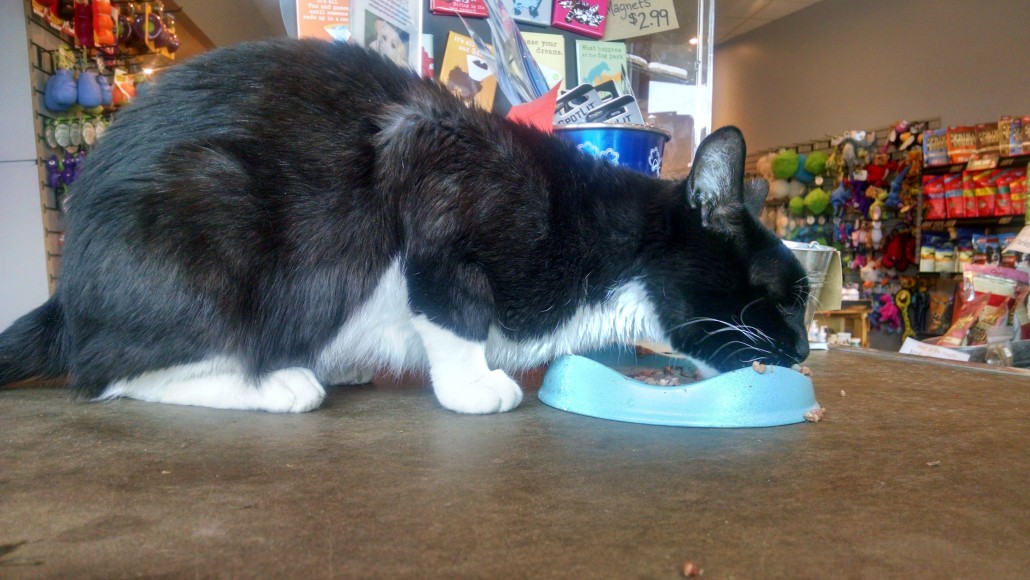
Starting this month, we’ve decided that The Happy Beast will be phasing out kibble for cats, and that we’ll stop carrying it completely as of July 2016! We know this may come as a surprise to a few of you so we wanted to explain our thinking and provide an opportunity for our customers to ask questions. We’re looking forward to this next stage in our growth and evolution and hope you’ll join us!
For years, we have committed a great deal of our time to educating our customers and increasing awareness about why kibble can be detrimental to a cat’s health. Despite this, we’ve continued to sell it. Over the years, it has become increasingly difficult to sell something that we believe contributes to a variety of the health issues we see in cats today. Selling kibble has become the equivalent of preaching health and wellness on one hand, and then eating a diet of fast food and potato chips on the other hand.
We think it’s important to point out that this topic is not black and white and there are certain circumstances where we recognize the benefits of providing a high-quality kibble for cats. For instance, shelters, rescue groups, and individual’s feeding barn cats, may not have the time or economic ability to feed a diet of raw or canned food to dozens of cats. Then again, we cannot ignore the fact that when you look at the Top 10 Reasons cats go to the vet (reported by VPI pet insurance) we feel that a majority of those visits could have been avoided or remedied by feeding a biologically-appropriate diet of raw or canned food that consists primarily of animal protein.
What really got us moving in this direction was my recent interview with Dr. Angie Krause. In that interview, I learned that by the time Dr. Krause entered veterinary school in 2003, she was taught that cats should be on a canned food diet, and that kibble was no longer accepted as a good diet option for cats. I was both pleasantly surprised by this information and disheartened. If the vet community was now being taught that kibble is not appropriate for cats, then why is it still used and recommended so prolifically?
Let’s quickly review a couple of the most common areas of discussion: the potential health issues and the perceived reduced costs of feeding kibble:
Where kibble falls short and the potential health issues:
Read more in our “Kibble Transition Guide for Picky Cats” blog post
- Too low in moisture. Can lead to kidney and urinary tract issues.
- Too low in animal protein. Animal proteins provide the full spectrum of amino acids, including Taurine, which a cat needs, whereas plant-based proteins such as peas and potatoes do not. Peas and potatoes are the most common “binder” found in grain-free kibble, and can make up as much as 44% of the total kibble diet!
- Too high in Carbohydrates. All kibble, even “grain-free,” contains an average of 25% carbohydrate (a cat’s natural diet is generally less than 2%). This excess amount of carbohydrates promotes obesity because it is higher in sugar and causes cats to overeat. Cats tend to overeat kibble because the carbohydrates in it do not trigger satiety like fats and proteins do. Additionally cats lack the enzyme, Amylase, which is responsible for digesting carbohydrates
Perceived reduced costs of feeding kibble:
- Admittedly, it’s difficult to determine exactly what the cost savings would be to feed a biologically appropriate diet (and avoid extra vet visits) versus the average cost an owner would incur at the vet in order to treat a specific health condition.
- From my personal experience, I know that I spent well over $8k over the course of four years to help my cat with irritable bowel syndrome (IBS). The cost to feed raw for an average ten-pound cat would be about $240/year, and the cost to feed canned would be about $480/year. (Costs vary depending on the diet, but yes, feeding raw can be even cheaper than feeding canned!) For my cat, switching him to a raw food diet made a tremendous difference; both in terms of his overall health as well as avoiding extra visits to the vet. I only wish I had made the transition sooner.
In summary, we know that change can be difficult. For example, why should a pet food company shift away from producing a profitable line of kibble cat food when the consumer demand still exists? Or why should a pet food store stop selling it? For us, we’ve decided to stop walking the line of this debate and stop carrying kibble for cats. We’re excited to have you join us, and we’ll continue working to provide the best-possible education and products to improve the health and happiness of cats.
We’d love to have you stop by the store or comment on this blog post to ask any additional questions. Or just use the hashtag #CatsEatMeat on social media to show your support and join the movement!